

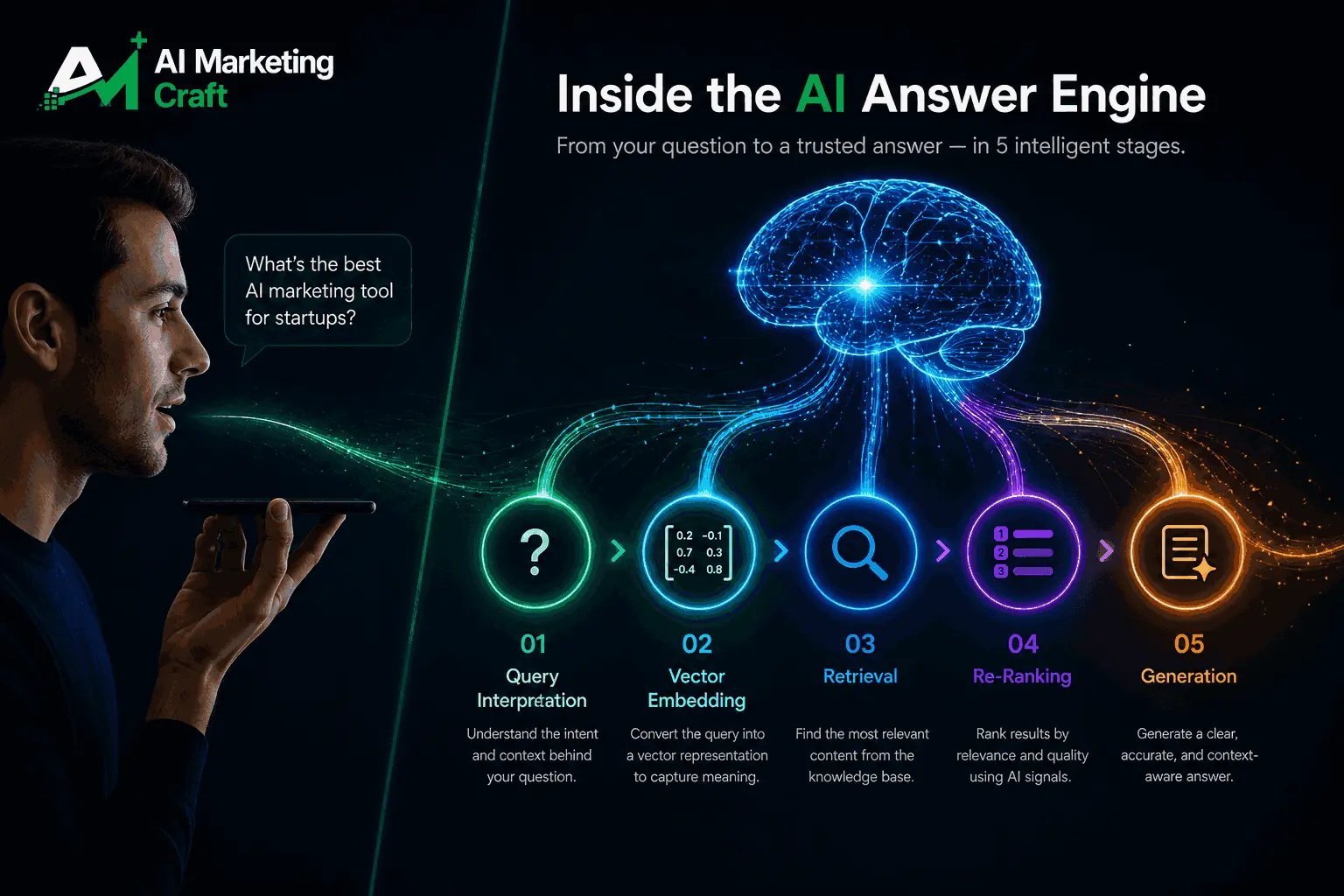
Answer Engine Optimization (AEO) works through a 5-stage process called Retrieval-Augmented Generation (RAG): the AI interprets your query, converts it into a vector embedding, retrieves semantically relevant content from the web, re-ranks sources by trust and relevance, then generates an answer that cites selected passages. Optimizing each stage is how you get your brand cited instead of ignored.
That’s the 50-word version. Keep reading if you want to know exactly where to intervene in that pipeline — and why most marketers are currently invisible inside it.
Why You’re Probably Already Losing Ground
Here’s a number that should make you pause: position 1 on Google now gets 58% fewer clicks when an AI Overview is present, according to Ahrefs’ December 2025 study of 300,000 keywords.
You fought hard for that ranking. You built the backlinks, optimized the title tags, and hit publish at 9 AM on a Tuesday. And now an AI engine reads your page, extracts the useful bit, and answers the user’s question without ever sending them to your site.
ChatGPT now handles over 2 billion queries daily. Google AI Overviews appear in nearly 55% of all Google searches. And Gartner projects traditional search volume will drop 25% by 2026 as users shift to AI chatbots and virtual agents.
The rules didn’t change gradually. They changed fast.
The good news? AI referrals to the top 1,000 websites grew 357% year-over-year, reaching 1.13 billion visits in June 2025. And visitors who arrive via AI citations convert at dramatically higher rates than traditional organic traffic — AI Search traffic converts at 14.2% compared to Google’s 2.8%.
So the channel is real, it’s growing fast, and the brands that understand how it works are already pulling ahead.
This is your guide to understanding exactly how, starting with the engine itself.
What Is Answer Engine Optimization, Actually?
Before we get into mechanics: what is answer engine optimization at its core?
Answer engine optimization is the discipline of making your content easy for AI systems to find, parse, trust, and cite. Unlike traditional SEO, which focuses on ranking for clicks, AEO measures success by citation: Does your brand appear as a named source when ChatGPT, Perplexity, Gemini, or Google AI Overviews generate an answer to a relevant query?
That’s it. Not rankings. Not impressions. Citations.
How Does Answer Engine Optimization Work? (The 5-Stage RAG Pipeline)
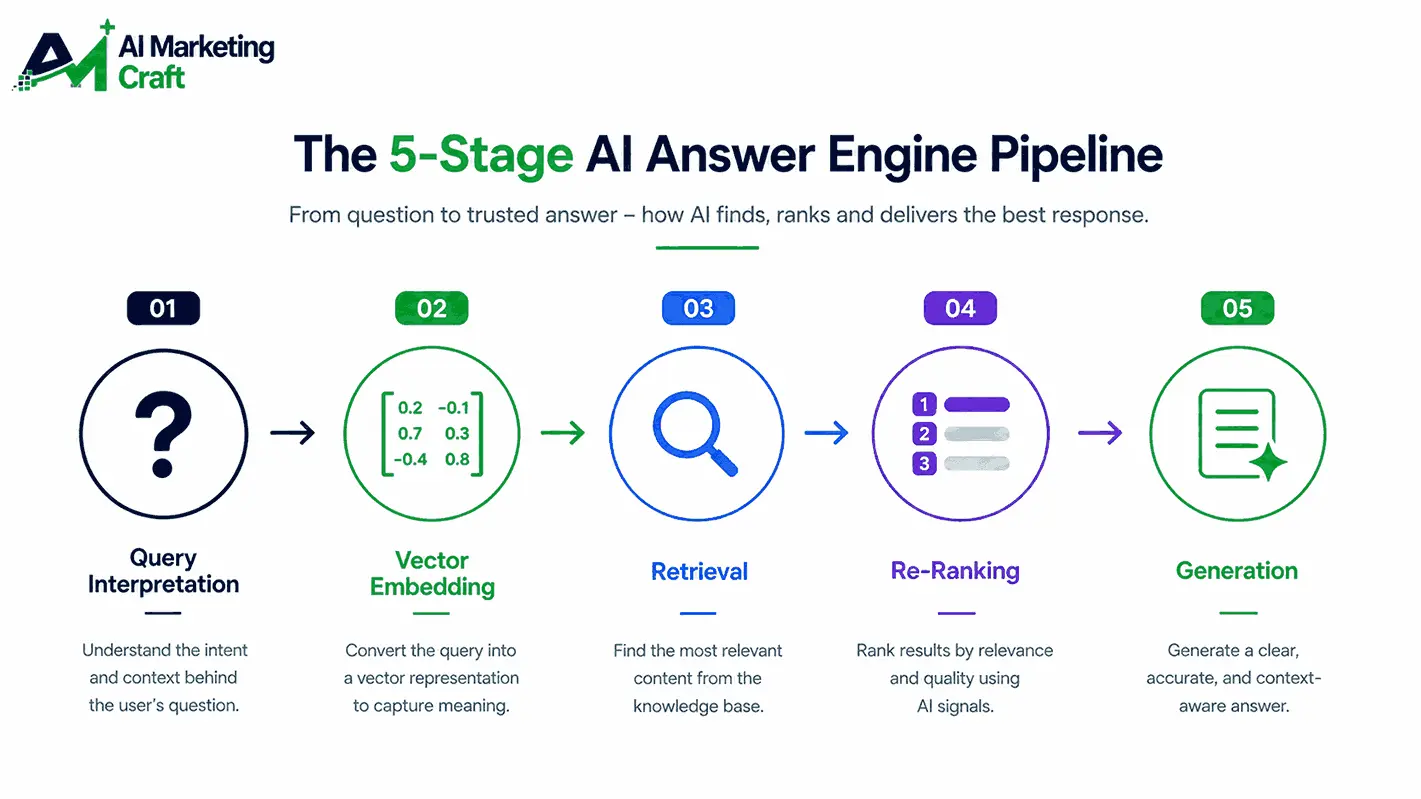
Most people know the term RAG. Fewer understand what actually happens inside it — and what it means for their content strategy.
Here’s how answer engine optimization works behind the scenes.
Stage 1 — Query Interpretation (Intent & Entity Mapping)
When you type “best CRM for SaaS startups under 50 employees” into ChatGPT or Perplexity, the AI doesn’t just take those words and run a basic keyword match. It parses your intent.
The system identifies what kind of answer you need (comparative? definitional? procedural?), extracts the key entities in your query (CRM software, SaaS, startup size), and infers context it can’t see directly — like the fact that you probably want pricing information, integration options, and real user opinions, not a dry definition of what CRM stands for.
The AI breaks long questions into shorter sub-queries — called fan-out queries — and runs separate searches for each one. If someone asks “What is the best accounting software for a freelancer who invoices international clients?” the AI might search for “best freelance accounting software 2026” and “accounting software international invoicing” as two separate queries. Your content needs to match those shorter queries, not just the full question.
What this means for your content: Map your content to sub-questions, not just the primary topic. A page that answers five related sub-questions has five chances to get retrieved. A page that answers only the main question has one.
Stage 2 — Vector Embedding (How Meaning Gets Measured)
This stage is where math takes over from language, and most marketers stop paying attention. Don’t.
The user’s query is converted into a mathematical representation known as a “vector embedding.” So is every piece of indexed content. The AI measures semantic distance — how similar two meanings are — by comparing these vectors in a high-dimensional mathematical space.
Think of it like this: if your content talks about “machine learning-powered lead scoring” and a user asks about “AI for sales automation,” the vector embeddings of those two phrases may sit very close together in semantic space, even though they don’t share a single word. That proximity is what gets your content retrieved.
This is why keyword stuffing is functionally dead for AEO. The AI doesn’t need you to repeat its exact words. It needs you to cover the concept with enough depth and specificity that your content registers as semantically relevant.
What this means for your content: Write for topics, not just terms. Cover related concepts, use specific entities, define key ideas clearly. Depth and semantic coverage matter more than keyword density.
Stage 3 — Retrieval (Which Sources Even Get Considered)
Here’s the stage where most brands get quietly eliminated.
Each AI platform searches against a different web index. ChatGPT uses Google’s search index via SerpAPI. Perplexity runs its own web crawler called PerplexityBot. Google AI Overviews pull from Google’s own search index. The system selects the most relevant results and extracts specific passages, facts, and data points.
This means your content needs to be crawlable — not just by Googlebot, but by the AI-specific crawlers like GPTBot and CCBot. If these bots are blocked in your robots.txt, you’re invisible to the retrieval layer entirely. You’ve opted yourself out of citation before the AI even reads a word you’ve written.
Beyond crawlability, AI systems using RAG retrieve passages of 200–400 words, not entire pages. They look for blocks of content that contain verifiable, quotable facts: specific numbers, named sources, defined terms, and concrete outcomes. Vague claims like “our platform improves productivity” get skipped. Specific claims like “teams using our platform report a 34% reduction in project completion time, based on a survey of 200 customers” get cited.
What this means for your content: Make your pages crawlable to AI bots. Structure your content in extractable 200–400 word chunks. Every paragraph should be quotable on its own — complete idea, specific data, clear attribution.
Stage 4 — Re-Ranking (How Trust Gets Assigned)
The AI now has a shortlist of candidate sources. This stage decides which ones to actually use.
Re-ranking combines multiple trust signals simultaneously:
- Domain authority and citation history — Has this source been cited before? Is it recognized as an expert on this topic?
- Factual accuracy and consensus — Does this content agree with the broader body of information the AI has been trained on or can retrieve?
- Recency — Pages updated within 2 months earn 28% more citations than older content.
- Structured attributes — Brands with 8 or more structured attributes get cited 4.3x more than brands with fewer than 3. Each additional structured attribute adds 8.3% median coverage.
- Source signals — Named authors with credentials, organizational schema markup, and verifiable expertise all factor in.
AI systems evaluate source credibility when deciding what to cite. Including statistics with named sources carries more weight than unsourced claims. “According to Gartner’s 2025 forecast” is treated differently than a claim with no attribution. Author bylines with relevant credentials and first-hand experience further strengthen a source’s chances of being selected.
What this means for your content: Cite your sources explicitly. Add author bios with real credentials. Update your most important pages at least every two months. The more structured and verifiable your content, the higher it re-ranks.
Stage 5 — Generation (Where Your Brand Gets Named — or Doesn’t)
This is the stage you see. The AI constructs a synthesized answer, drawing from the top re-ranked sources, and names them as citations.
But there’s a nuance worth understanding: the AI doesn’t just paste in whoever ranked #1. It selects the most extractable passage that directly addresses the specific sub-query it’s answering at that moment in the response.
Around 80% of LLM citations don’t even rank in Google’s top 100 for the original query. That’s not a typo. Being cited by ChatGPT and ranking on Google are largely independent outcomes — driven by different signals, different crawlers, and different evaluation frameworks.
Which means an entirely new category of content can win here: clear, structured, fact-dense content on topics where you have genuine expertise — even if you’re not a domain authority in traditional SEO terms.
What this means for your content: Structure your content to be passage-extractable. Answer the specific sub-question in the first 1–2 sentences of each section. The rest of the paragraph is supporting evidence.
What AI Engines Specifically Look For When Selecting Sources
So you understand the pipeline. Now let’s get practical: what actually makes content get selected?
Content with statistics, citations, and quotations achieves 30–40% higher visibility in AI responses. Pages with well-organized headings are 2.8x more likely to earn citations in AI search results.
Breaking that down into actionable signals:
1. Answer-First Structure AI models reading via RAG prioritize information that is immediately accessible. The inverted pyramid style — stating the most critical, definitive answer at the very top of your page — consistently outperforms content that buries the lead.
2. Specific, Verifiable Facts Generic claims disappear. “Our software saves time” gets skipped. “Our software reduced average onboarding time from 14 days to 6, based on data from 300 enterprise customers” gets extracted. The more specific and attributable your claims, the more citeable they become.
3. Named Entities and Frameworks AI systems retrieve conceptual structures. If you name a framework, define each component, and apply it to a concrete example, that section becomes extractable as a teachable concept. Consistent author attribution, an organizational schema, and references to your brand as an entity strengthen the trust signals that AI systems use.
4. Structured Comparisons and Tables Structured comparisons and tables are retrieved preferentially because they are pre-organized for extraction. If you’re comparing options, formats, or outcomes — use a table. It’s not a stylistic choice; it’s an optimization decision.
5. Recency Signals AI systems track when content was last verified. Staleness hurts. Regular updates — even small factual refreshes — keep your content competitive in the re-ranking layer.
How Content Structure Affects Your AI Citation Rate
Content structure for answer engine optimization is one of the most direct levers you can pull.
Here’s the core principle: AI engines extract passages, not pages. So your entire page structure should be built around the idea that each section might be read in isolation by a machine that has never seen the rest of your content.
The Passage-First Structure
Each section of your content should follow this pattern:
- Direct answer in sentence 1–2 — What is the answer to this specific sub-question?
- Evidence in sentences 3–5 — What data, source, or example supports that answer?
- Context in sentences 6–8 — What does a human reader need to understand this fully?
This is different from how most blog content is written, where context comes first and the answer arrives at the end of a paragraph. For AI extraction, that structure means the most citeable information is buried where the retrieval system is least likely to find it.
Heading Architecture for AI Extraction
Use H2 and H3 headings as question-answer pairs. When your H2 asks a question and the first paragraph below it directly answers that question, you’ve created a self-contained extractable unit that every AI engine can identify and use.
Avoid vague headings like “Key Considerations” or “Important Factors.” Use specific, searchable questions that map to how real users phrase queries: “What makes content get selected as an AI citation?” performs better than “Selection Criteria.”
The Role of Lists and Tables
Structured lists and comparison tables serve a dual purpose in AEO. First, they signal clear organization to the re-ranking algorithm. Second, they contain information pre-packaged for extraction — no parsing required.
| Content Element | Traditional SEO Value | AEO Citation Value |
|---|---|---|
| Long-form narrative paragraphs | High | Medium (if answer-first) |
| Comparison tables | Medium | Very High |
| FAQ sections with direct answers | Medium | Very High |
| Bulleted lists with specific data | Medium | High |
| Generic introductory paragraphs | Medium | Low |
| Named frameworks with definitions | Low | Very High |
| Statistics with source attribution | High | Very High |
Schema Markup and Structured Data — The Technical Layer
This is the section most content marketers skip, which is exactly why it’s a competitive advantage.
Structured data for answer engine optimization functions as a machine-readable translation of your content. While your prose tells a story, schema markup tells the AI what type of content this is, who wrote it, when it was published, and what entities it references.
The most impactful schema types for AEO in 2026:
FAQPage Schema When you have a question-answer section (like the one in this post), marking it up with FAQPage schema makes every Q&A pair explicitly retrievable. The AI doesn’t have to infer that this is a Q&A — you’ve stated it in structured data.
Article Schema + Author Schema Author credibility is a re-ranking signal. If your content has author: {name: “Jane Smith”, jobTitle: “Senior SaaS Marketing Strategist”, sameAs: “https://linkedin.com/in/janesmith”} embedded in your schema, you’ve given the AI a verifiable entity to evaluate. Nameless content is treated as less authoritative by default.
Organization Schema Brand-level schema that establishes your organization as a named entity — including your founding date, industry, service area, and official social profiles — strengthens the trust signals attached to every piece of content on your domain.
HowTo Schema For procedural content, HowTo schema marks each step explicitly. The AI can then extract individual steps as citations without needing to infer the structure from your prose formatting alone.
If you want to go deeper on this, the complete breakdown is in our guide on how to implement schema markup correctly for AEO.
How Does AEO Differ from Traditional SEO?
This is one of the most searched questions in this space and the answer is more nuanced than “SEO is dead, AEO is next.”
| Dimension | Traditional SEO | Answer Engine Optimization |
|---|---|---|
| Goal | Rank #1 for target keyword | Get cited as a source in AI answer |
| Success metric | Organic traffic, SERP position | Citation rate, AI share of voice |
| Primary signal | Backlinks + on-page keywords | Structured data + semantic authority |
| Content format | Long-form optimized posts | Extractable, passage-friendly sections |
| Technical requirements | Crawlability, Core Web Vitals | AI bot access, schema, entity clarity |
| Keyword strategy | Keyword density + placement | Full semantic coverage of topic intent |
| Trust signals | Domain authority, backlinks | Author credentials, verified facts, citations |
| Update frequency | Occasional refresh | High (recency impacts citation rate) |
| Platform | Google Search | ChatGPT, Perplexity, Gemini, Google AI |
The critical insight: traditional SEO and AEO are not competing strategies. Integrating AEO with existing SEO roadmaps means updating processes rather than replacing them, adding answer-first sections to existing SEO pages, including schema as a standard part of content production, auditing entity consistency during technical SEO checks, and evaluating both traditional rankings and AI citations in reporting. AEO is the “zero-click layer” of SEO strategy.
Rank to be cited, not just to be clicked.
AEO Ranking Factors: What the Data Shows in 2026
Based on current research, here are the most consistently validated ranking factors for AI citation selection:
- Factual density: More verifiable facts per paragraph → higher retrieval priority
- Recency: Updated content earns 28% more citations than stale content
- Structured attributes: 8+ structured data points → 4.3x citation rate
- Heading-question alignment: Question-based H2/H3s → 2.8x citation likelihood
- Author E-E-A-T signals: Named authors with verified credentials → stronger re-ranking position
- AI bot accessibility: Blocking GPTBot or CCBot → complete elimination from retrieval
- Source attribution: Naming your data sources explicitly → higher AI trust score
- Schema completeness: FAQPage + Article + Organization schema → triple-layer signal
The AEO vs SEO Traffic Reality Check
Around 93% of AI search sessions end without a website click, and AI Overviews reduce clicks to the top-ranking page by 58%, making answer visibility more important than traditional rankings.
So why optimize for a channel where most people don’t click through?
Three reasons:
1. Brand imprinting at the moment of research. When ChatGPT cites your brand name while answering a question a buyer is actively researching, it builds awareness and credibility without a click ever happening. That reader now associates your brand with the right answer.
2. The clicks that do come through convert better. Someone who clicked through from a ChatGPT citation to your site already had their intent shaped by the AI’s framing of your brand as an authority. Semrush’s data shows visitors arriving from AI search experiences convert 4.4 times better on average than visitors from classic organic search.
3. The channel is still early. AI platforms generated 1.13 billion referral visits in June 2025, a 357% increase from June 2024. AI-sourced sessions surged 527% year-over-year in the first half of 2025. The brands investing in AEO today are positioning themselves for compounding returns as the channel matures.
Three Immediate Steps to Start Optimizing for Answer Engines
You don’t need to rebuild your entire content library to start winning citations. Here’s where to focus first.
Step 1: Audit Your AI Bot Accessibility
Check your robots.txt file right now. If you see User-agent: GPTBot or User-agent: CCBot followed by Disallow: /, you are invisible to the world’s largest AI retrieval systems. Remove those disallow rules immediately.
Then verify crawlability by checking whether your most important pages appear when you paste the URL into ChatGPT with a prompt like “What does this page say about [topic]?” If ChatGPT returns nothing, the page isn’t being retrieved.
Step 2: Restructure Your Top 5 Pages for Passage Extraction
Take your five highest-traffic pages and apply this transformation:
- Move the direct answer to the first paragraph of each section (not the last)
- Add at least one H2 or H3 that is phrased as a direct question
- Replace vague claims with specific, attributed data points
- Add an FAQ section at the bottom with 5–8 question-answer pairs using FAQPage schema
- Update the “last modified” date after publishing changes
This single structural shift is responsible for the majority of early AEO citation wins that agencies see in their first 60 days.
Step 3: Build Schema Into Your Publishing Workflow
Schema markup isn’t a one-time technical task — it’s a publishing standard. Every new piece of content that goes live should ship with Article schema (including author entity data), FAQPage schema for any Q&A sections, and HowTo schema for any procedural content.
If you want the full AEO implementation framework with every step mapped out, that’s covered in the implementation guide.
Real-World AEO in Action: What Getting Cited Actually Looks Like
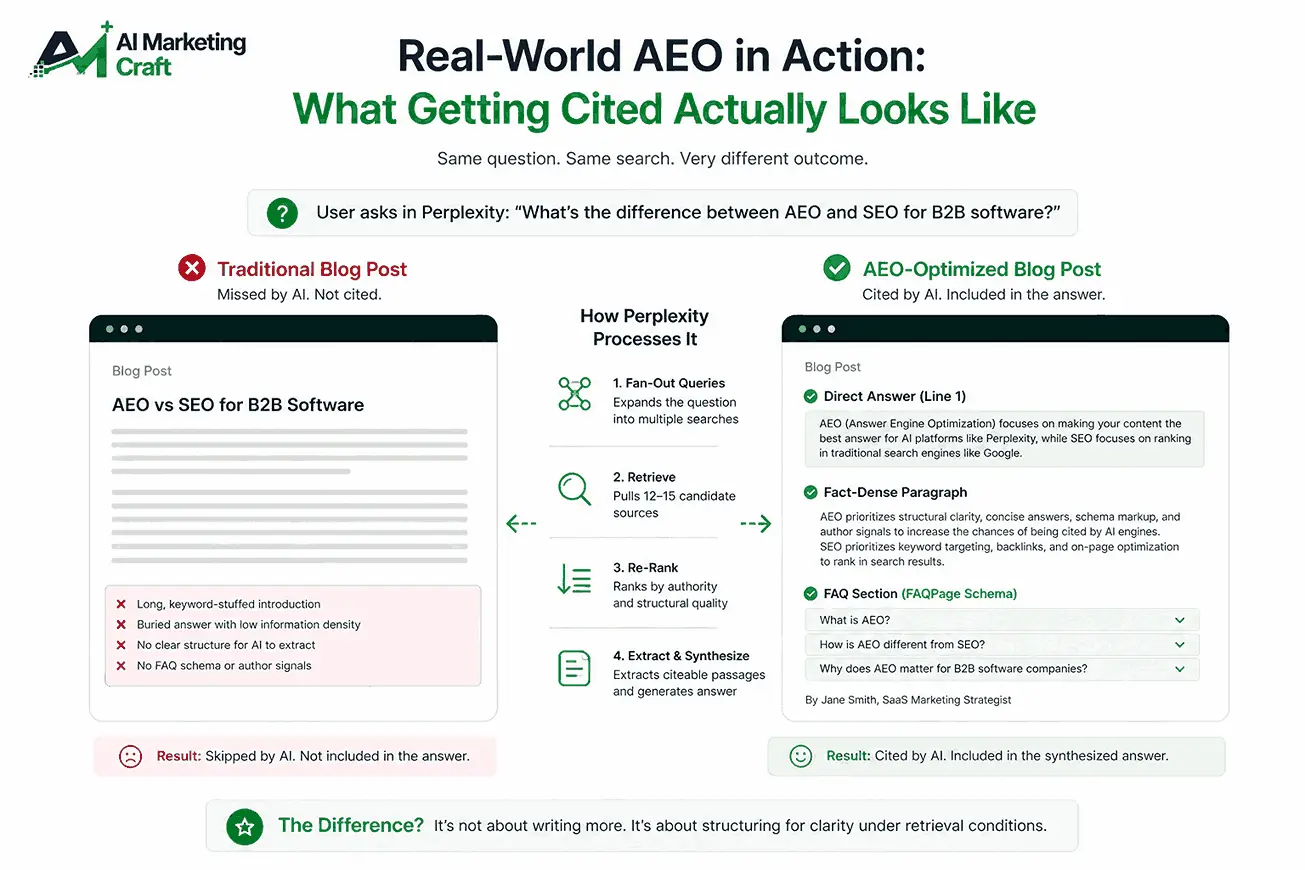
Here’s a concrete scenario.
A CMO at a SaaS company types into Perplexity: “What’s the difference between AEO and SEO for B2B software?”
Perplexity runs a fan-out query set: “AEO vs SEO B2B”, “answer engine optimization SaaS”, “SEO vs AI search for software companies.” It retrieves 12–15 candidate sources, re-ranks them by authority and structural quality, extracts the most citeable passages, and generates a synthesized answer.
If your page has a direct, fact-dense answer to that question structured as a clean paragraph with a named author and FAQPage schema, you get named. If your page has a keyword-stuffed introduction that takes 200 words to get to the point, you get skipped.
The difference isn’t writing quality in the traditional sense. It’s structural clarity under retrieval conditions.
Tools Used in Answer Engine Optimization
A quick reference of the tools that support AI-powered answer engine optimization in 2026:
| Tool | Primary Use |
| HubSpot AEO | Citation tracking across ChatGPT, Perplexity, Gemini |
| Frase.io | Content structure optimization for AI extraction |
| Semrush | Topic research, keyword mapping, entity coverage |
| Ahrefs | Citation analysis, competitor AEO benchmarking |
| Superlines / Profound | AI share-of-voice measurement |
| Schema.org + Google SDTT | Structured data validation |
| Pixelmojo Radar | Technical AEO readiness auditing |
| Search Console + GA4 | Baseline traffic and AI referral tracking |
For a full breakdown of every tool’s strengths, pricing, and use cases, the best AEO tools comparison for 2026 covers that in detail. And once you’re running, you’ll want to know how to track your AEO performance with the right metrics because pageviews and rankings won’t tell you whether your citations are growing.
Future Trends: What AEO Looks Like in 2027
A few signals worth watching as this discipline matures:
Platform diversification becomes mandatory. Only 12% of sources cited across ChatGPT, Perplexity, and Google AI Overviews overlap. Only 11% of domains are cited by both ChatGPT and Perplexity. That means optimizing for one platform won’t transfer to others. Brand visibility measurement and content optimization will become platform-specific disciplines — much like how SEO tactics differ between Google and Bing today.
AI agents will change retrieval entirely. ChatGPT’s Agent Mode and Instant Checkout features signal a shift from AI as information retrieval to AI as decision-maker and action-taker. When an AI agent is buying software on behalf of a procurement team, the content it consults to make that recommendation is the new “conversion funnel.”
Entities will matter more than keywords. The long-term trajectory of AI search is toward knowledge graph retrieval — where your brand, your products, and your expertise are represented as connected entities in a semantic web, not as pages to be ranked. Building entity clarity now is building your future citation infrastructure.
How does answer engine optimization work?
Answer engine optimization works through a 5-stage process called Retrieval-Augmented Generation (RAG). First, the AI interprets the user’s query and extracts intent. Second, it converts both the query and candidate content into vector embeddings to measure semantic similarity.
Third, it retrieves relevant passages from its web index. Fourth, it re-ranks those passages by authority, recency, and trust signals. Fifth, it generates a synthesized answer that cites the highest-ranked passages. Optimizing your content at each stage increases your probability of being selected as a citation.
How does AEO differ from traditional SEO?
Traditional SEO focuses on earning rankings and driving click-through traffic. AEO focuses on earning citations and building brand visibility inside AI-generated answers. SEO measures success with traffic and rankings.
AEO measures success with citation rate and AI share of voice. The two overlap on strong SEO fundamentals (crawlability, E-E-A-T, authority), but the content format, structural requirements, and success metrics are meaningfully different.
What happens inside an AI engine when someone asks a question?
The AI breaks the question into multiple sub-queries (fan-out queries), converts each into a semantic vector, retrieves relevant content from its web index, re-ranks sources by authority and relevance, extracts specific 200–400 word passages, and synthesizes a response that cites the best-matched passages. The entire process happens in seconds. Your content either surfaces cleanly in the retrieval stage or doesn’t get considered at all.
What makes content get selected as an AI citation?
The strongest predictors of AI citation are: answer-first paragraph structure (direct answer in the first 1–2 sentences), specific and verifiable data points with named sources, well-organized headings that match how users phrase questions, schema markup (especially FAQPage and Article schema), named author credentials, and regular content updates. Brands with 8 or more structured attributes are cited 4.3x more frequently than those with fewer than 3.
How does content structure affect AI citation rates?
Significantly. Pages with well-organized headings are 2.8x more likely to earn citations. Content structured as self-contained extractable passages, each section answering its specific sub-question in the opening sentences, is retrieved and cited far more consistently than narrative content, where the key answer is buried. Tables, structured lists, and FAQ sections are particularly high-value formats for citation extraction.
How answer engine optimization works behind the scenes
Behind the scenes, AEO functions through machine-readable signals that operate below the visible text layer. Schema markup tells AI engines what type of content a page contains. Vector embeddings determine semantic relevance without keyword matching.
Author and organizational entity data feeds the trust re-ranking model. Content freshness timestamps affect retrieval priority. None of this is visible to a human reader — but all of it shapes whether your content ever gets retrieved, re-ranked, and cited.
What role does schema markup play in answer engine optimization?
Schema markup is a direct communication layer between your content and AI retrieval systems. FAQPage schema makes Q&A pairs explicitly extractable. Article schema with author entity data strengthens E-E-A-T signals at the machine-readable level.
Organization schema establishes your brand as a verified entity. HowTo schema makes procedural steps individually citable. Without schema, the AI must infer all of this from your prose — which it does imperfectly and inconsistently.
How to optimize content for AI answer engines
Start with these five actions: (1) Ensure GPTBot and CCBot are not blocked in your robots.txt. (2) Restructure your most important pages to lead each section with a direct answer. (3) Replace vague claims with specific, attributed data points.
(4) Add FAQPage schema to any Q&A sections. (5) Add Article schema with named author entity data to every published post. These five changes address the retrieval, re-ranking, and generation stages of the RAG pipeline simultaneously.
What are the steps to optimize content for answer engines?
The core steps to optimize content for answer engines are: (1) Audit AI bot accessibility in robots.txt, (2) Restructure content with answer-first paragraph format, (3) Cover topic intent with semantic depth rather than keyword repetition, (4) Include specific data points with named sources.
(5) Implement schema markup for FAQ, Article, and Organization types, (6) Add or update author bios with verifiable credentials, (7) Refresh published content every 30–60 days, (8) Test citation presence by querying your target topics in ChatGPT and Perplexity directly.
Can you explain how answer engine optimization actually works?
At its simplest: AEO is the practice of making your content machine-readable, factually verifiable, and structurally clear enough that AI engines select it as a trusted source when generating answers. The mechanism is RAG — a 5-stage pipeline that retrieves, evaluates, and synthesizes content from across the web. You’re not optimizing for an algorithm that counts keywords. You’re optimizing for a system that evaluates semantic relevance, factual density, and source credibility simultaneously, at inference time, for every single query it receives.
Conclusion: Where to Focus Next
Here’s the honest summary: most of the content on the internet was not written to be cited by AI engines. It was written to rank for keywords, satisfy word count targets, and pass readability scores. That content is invisible in the RAG pipeline — not because it’s bad, but because it wasn’t built for how this technology retrieves information.
The brands that win in AI search will not necessarily be the ones with the biggest budgets or the most backlinks. They’ll be the ones who understood the retrieval pipeline early and built their content architecture around it.
You now understand the five stages. You know what signals matter at each stage. You know where most content fails — and exactly how to fix it.
The next step is implementation. If you’re ready to put this into practice, the full AEO implementation framework walks through every step in sequence. And if you want to understand how tooptimize per platform: ChatGPT, Perplexity, Google, and Gemini — separately, that’s the platform-specific guide.
Want Help Getting Your Brand Cited by AI?
AI Marketing Craft helps businesses build the content architecture, schema systems, and entity authority needed to appear in AI-generated answers. If you want to audit your current AI citation rate and understand where your biggest gaps are, start here at aimarketingcraft.com.
The brands getting cited right now didn’t stumble into it. They built for it.
Sources: Ahrefs (December 2025), Erlin data (2026), Frase.io (2026), Gartner (2024–2026), Superlines AI Search Statistics (March 2026), Conductor 2026 Benchmarks, Semrush AI Search Study, Pixelmojo analysis (February 2026), SE Ranking Research (2025), LLMrefs (2026), Similarweb (March 2026), BrightEdge 16-month study (2025), Vegavid analytics modeling (March 2026).