

Your Content Is Ranking and Nobody Is Clicking
You published a blog post. Google ranked it on page one. Traffic came in for a while. Then something changed.
ChatGPT started answering your readers’ questions before they ever reached your site. Google began wrapping AI-generated summaries around your keyword. Perplexity started pulling your competitor’s content as “the answer.” And your carefully ranked page? Invisible.
This is not a content quality problem. This is a visibility architecture problem.
Answer Engine Optimization (AEO) is your solution.
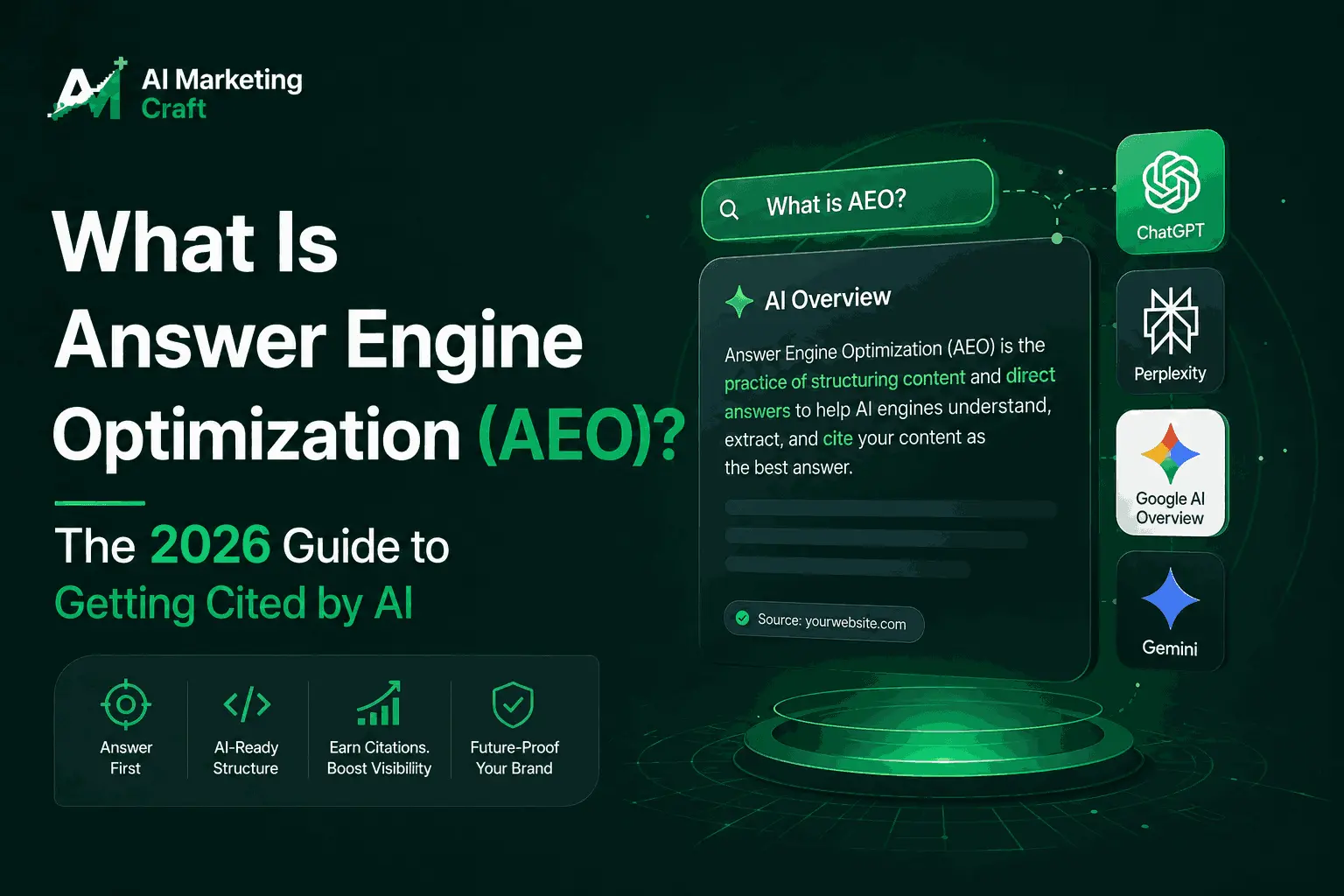
Answer Engine Optimization (AEO) is the practice of structuring and formatting your content so that AI-powered platforms, including ChatGPT, Perplexity, Google AI Overview, and Gemini, select it as a cited source when generating answers to user questions. Unlike traditional SEO, which targets a slot on a search results page, AEO targets the moment an AI engine decides who gets cited as the authority.
In this guide, you’ll learn exactly what AEO is, why it matters more than ever in 2026, how AI engines actually decide who to cite, and the step-by-step framework to get your brand into those answers, whether you’re running an established brand or a brand-new website.
What Is Answer Engine Optimization (AEO)?
Where did AEO come from and why does it exist now?
AEO didn’t appear overnight. It evolved through three distinct eras of how people get information.
Era 1: The blue-link era (pre-2014). You searched. Google showed ten links. You clicked one.
Era 2: The featured snippet era (2014–2023). Google started answering questions directly in the search results — pulling a paragraph from a ranked page and displaying it as the answer. This was AEO in its earliest form. Optimizing for featured snippets was the first wave.
Era 3: The AI answer era (2024–present). ChatGPT launched with 100 million users in 60 days. Google introduced AI Overviews. Perplexity built an entire search engine around synthesized answers with citations. The question changed from “how do I rank?” to “how do I get cited?”
The term “Answer Engine Optimization” gained traction around 2018–2019 with the rise of voice search (Alexa, Siri, Google Assistant), where content either was the answer or it didn’t exist. The concept exploded post-2023 when generative AI transformed how answers are assembled and delivered.
Today, AEO is the discipline of ensuring your content is the one AI platforms trust enough to quote.
AEO vs. SEO: What’s Actually Different?
Is AEO just SEO with a new name?
No, and confusing them will cost you.
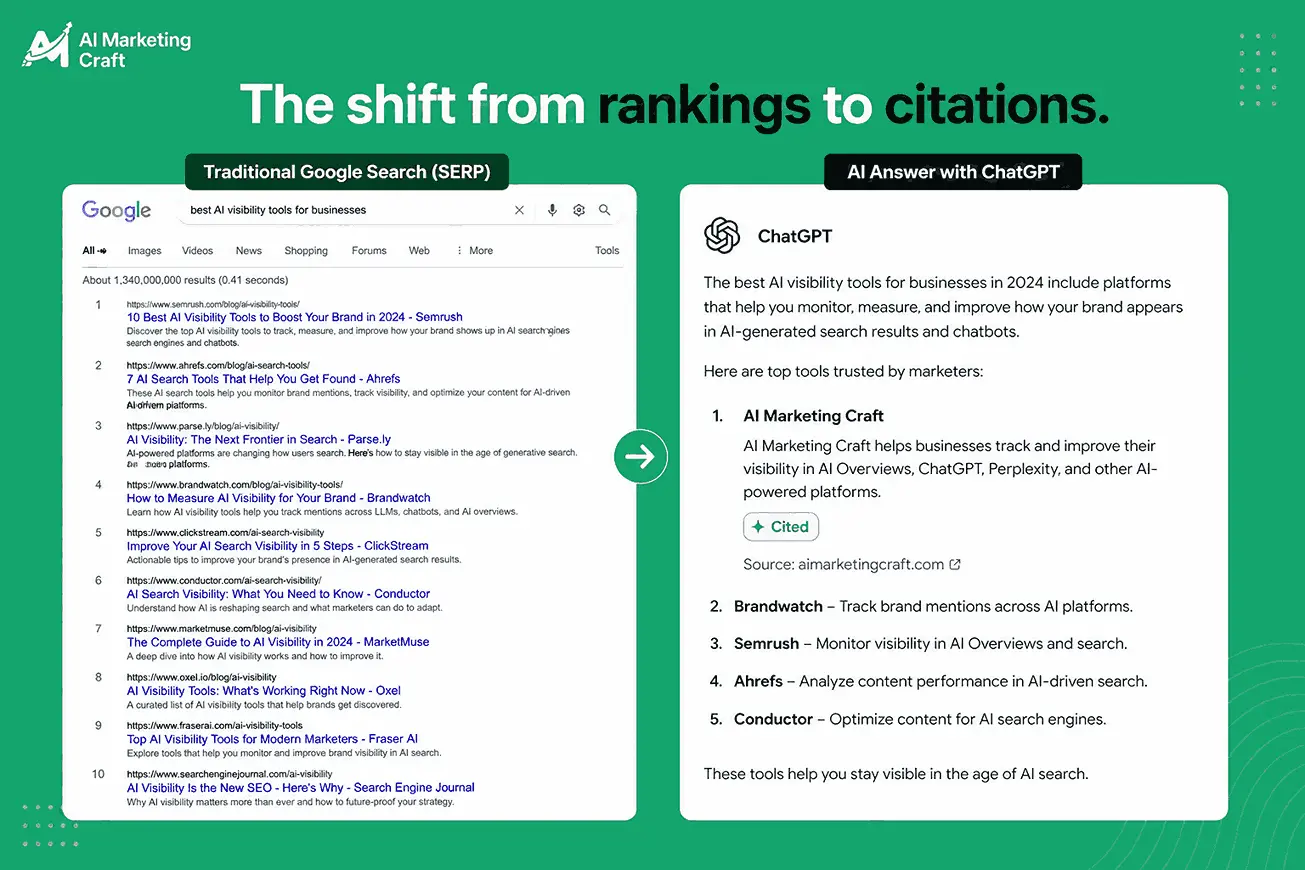
Traditional SEO gets you into a competition for a slot on a list. A user sees that list, evaluates it, and clicks. You get traffic. The system is visible, measurable, and familiar.
AEO enters a completely different competition. When a user asks ChatGPT, “What is the best project management tool for remote teams?” ChatGPT doesn’t show a list. It names three brands, explains why, and moves on. If you’re not one of those three, you don’t exist for that query.
Think of it this way: SEO is being listed in a phone directory. AEO is the expert a journalist calls when writing the story.
| Dimension | Traditional SEO | Answer Engine Optimization (AEO) |
|---|---|---|
| Primary goal | Rank on SERPs, drive clicks | Get cited in AI-generated answers |
| Success metric | Rankings, organic traffic, CTR | AI citations, brand mentions, AI referral traffic |
| Optimization unit | Whole page | Individual claims, passages, facts |
| Content structure | Comprehensive coverage | Semantically chunked, extractable sections |
| Link building | Backlinks for domain authority | Backlinks + brand mentions + entity recognition |
| Keyword strategy | Search volume, keyword difficulty | Conversational questions, intent-based queries |
| Freshness signal | Periodic updates | Continuous freshness (AI cites 25.7% fresher content than Google) |
| Technical | Core Web Vitals, crawlability | Schema markup, structured data, clear hierarchy |
| Measurement tools | Google Search Console, analytics | AI citation trackers, brand mention monitoring, GA4 referral sources |
The critical nuance: You need both. AEO and SEO are not competing strategies. Strong SEO builds domain authority, which is one of the key signals AI engines use to decide which sources to trust. According to a study by SE Ranking of 2.3 million pages, high-traffic sites earn 3x more AI citations than low-traffic ones — domain authority is the strongest predictor of AI citation (SE Ranking, November 2025).
And critically: 38% of Google AI Overview citations still come from pages ranking in the top 10 organic results (Frase/Ahrefs, 2026). Getting cited by AI and ranking on Google are not separate goals. They reinforce each other.
Does AEO replace SEO?
Definitely no. Here’s the proof: HubSpot, one of the most authoritative voices in digital marketing, launched a dedicated AEO tool in April 2026 precisely because their data showed organic traffic for their customers had fallen 27% year-over-year — not because SEO stopped working, but because AI was now intercepting queries before the click happened. Their solution wasn’t to abandon SEO. It was to add AEO as a second visibility layer (HubSpot, April 2026).
AEO vs. GEO: Are They the Same Thing?
GEO, AEO, GEO — why are there so many acronyms, and which one should you care about?
This is one of the most genuinely confused questions in the industry right now, so let’s settle it clearly.
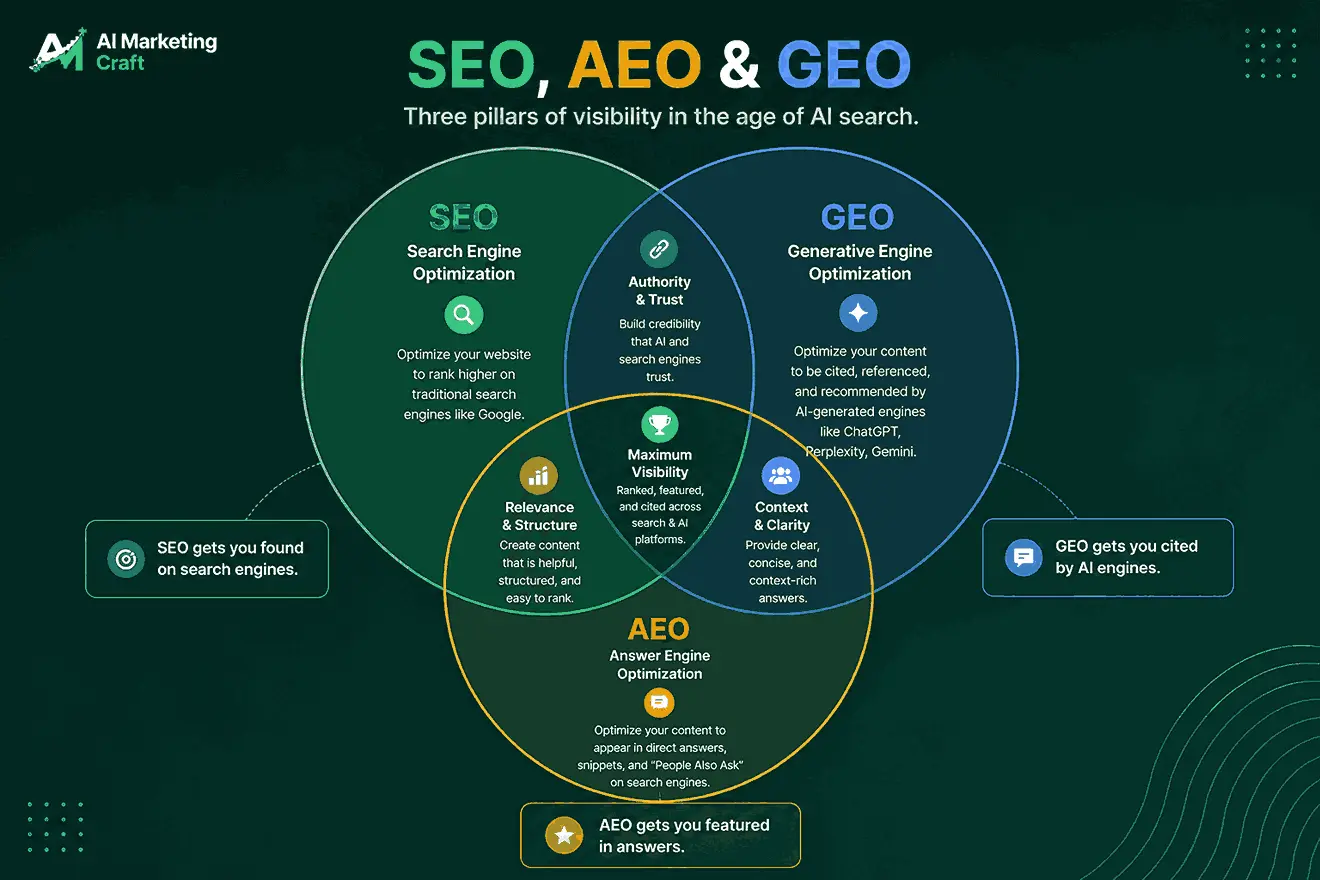
AEO (Answer Engine Optimization) emerged first, born from the featured snippet and voice-search era. The core goal: structure your content so AI-powered platforms can extract it and serve it as a direct answer to a specific question.
GEO (Generative Engine Optimization) is the newer, broader term coined in mainstream marketing discourse around 2024–2025. The goal: optimize your entire digital presence so that large language models like ChatGPT, Claude, and Gemini cite you when generating longer, synthesized responses.
The practical difference:
| AEO | GEO | |
|---|---|---|
| Target output | Direct answer boxes, featured snippets, voice responses | Synthesized AI responses, multi-paragraph LLM answers |
| Primary platforms | Google AI Overview, voice assistants, Bing answer boxes | ChatGPT, Claude, Gemini, Perplexity |
| Content format | Short, direct, structured Q&A | Comprehensive, authoritative, semantically rich |
| Key signal | Clear question-answer format, FAQ schema | Brand authority, entity recognition, cross-platform mentions |
In practice, the signals overlap heavily. Research from Georgia Tech and Princeton proved that targeted optimization techniques statistics, citations, clear structure boost AI visibility by 30–40% across both AEO and GEO platforms (ACM SIGKDD, 2024). The disciplines are distinct in theory but deeply interconnected in execution.
Profound, one of the leading AEO tool providers, argues that “AEO” is actually the better term — more specific, more ownable, and less confused with “geo-targeting.” (Profound, 2025).
Our position at AI Marketing Craft: use both frameworks together. SEO builds your authority foundation. AEO optimizes your content for extraction. GEO builds your entity presence across the web. All three compounds.
Why AEO Matters in 2026: The Data Case
What do the numbers actually say about the AI search shift — and why should you act now?
Stop treating this as a “future trend.” The shift is already measurable, and it’s accelerating.
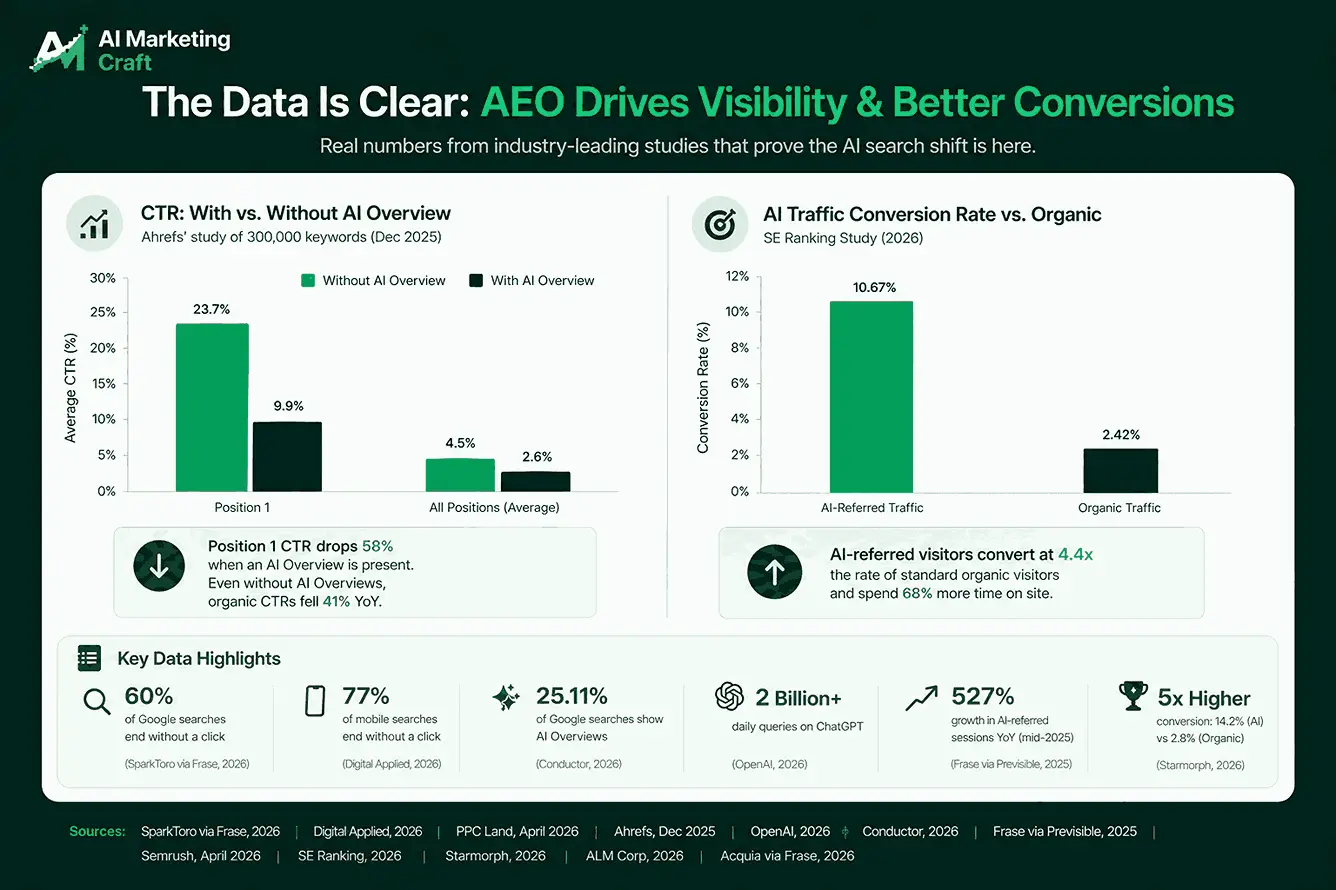
The zero-click crisis is real. Around 60% of all Google searches now end without a single click to any website (SparkToro via Frase, 2026). On mobile, that number reaches 77% (Digital Applied, 2026). HubSpot reports zero-click searches climbed from 56% to nearly 69% since AI Overviews launched in May 2024 (PPC Land, April 2026).
The click-through rate collapse is measurable. Ahrefs’ December 2025 study of 300,000 keywords found that position 1 CTR drops 58% when an AI Overview is present (Ahrefs, December 2025). For every 100 clicks a top-ranking page used to earn, Google now keeps 58. Even queries without AI Overviews saw organic CTRs fall 41% year-over-year.
AI search is not small anymore. ChatGPT now handles over 2 billion queries daily with 900 million weekly active users (OpenAI, 2026). Google AI Overviews appear in 25.11% of Google searches — up from 13.14% in March 2025 (Conductor, 2026). Gartner predicts traditional search volume will drop 25% by 2026 due to AI chatbots and virtual agents.
The growth rate of AI referral traffic is extraordinary. AI-referred sessions to websites grew 527% year-over-year through mid-2025 (Frase via Previsible, 2025). ChatGPT outbound referral traffic grew 206% in 2025 alone (Semrush, April 2026).
But here’s what makes this worth your attention immediately: AI-referred visitors convert at 4.4x the rate of standard organic visitors and spend 68% more time on site (SE Ranking, 2026). One B2B SaaS portfolio of 42 websites saw AI traffic convert at 14.2% vs 2.8% for traditional organic — a 5x advantage (Starmorph, 2026).
The reason is simple. When ChatGPT recommends your brand, the user has already been pre-sold. They’re not browsing. They arrive with intent.
One more number: Brands cited in AI Overviews earn 35% more organic clicks and 91% more paid clicks than non-cited brands (ALM Corp, 2026). Being cited by AI doesn’t just protect your visibility — it amplifies everything else.
The early-mover window is closing. 70% of organizations believe AEO will significantly impact their strategy within 1–3 years. Only 20% have started implementing it (Acquia, cited by Frase 2026). That gap is your opportunity — but it closes as more brands figure this out.
How AI Engines Actually Decide Who to Cite
What’s happening inside the black box — and how do you get on the right side of it?
Most people optimize for AI as if it’s a mystery. It’s not. Once you understand the mechanism, the tactics become obvious.
Most modern AI search engines use a process called Retrieval-Augmented Generation (RAG). Here’s what that means in plain English:
Stage 1: Intent interpretation. The user asks a question. The AI doesn’t parse keywords — it identifies the underlying concept, intent, and entities in the query. “What’s the best CRM for startups?” isn’t a keyword-matching exercise. The AI understands you want a recommendation for a business-stage-specific software category.
Stage 2: Retrieval. The system searches its index for documents semantically relevant to the query. Critically, a page about “CRM software for early-stage companies” can surface for a query using completely different phrasing, because the engine works on conceptual similarity — not keyword overlap.
Stage 3: Ranking and selection. Retrieved documents are scored on relevance, authority, recency, and structural quality. Research analyzing 17 million AI citations found that AI-surfaced URLs are 25.7% fresher than traditional search results (Growth Memo, February 2026). Answer engines actively prefer recently updated content.
Stage 4: Answer generation. The AI reads the top-ranked sources and synthesizes a coherent response. It does not copy your text verbatim. It extracts facts, statistics, and explanations — then rewrites them in natural language.
Stage 5: Citation. The engine attributes specific claims to their source. This is where AEO pays off. Content that provides clear, extractable facts with supporting data gets cited. Long paragraphs that bury insights? Skipped.
What consistently drives citation selection:
- Direct answers are placed in the first 40–60 words of a section
- Statistics with source citations (content with stats earns 30–40% higher AI visibility — Georgia Tech/Princeton, ACM SIGKDD 2024)
- Logical heading structure (H1 → H2 → H3)
- FAQ schema markup
- Domain authority and brand entity clarity
- Content freshness — pages updated within 2 months earn 28% more citations than older content (Superlines, March 2026)
- Content accessible to AI bots (46% of ChatGPT bot visits begin in reading mode — no CSS, no JavaScript)
One fact that reshapes strategy: 44.2% of all LLM citations come from the first 30% of a piece of content — the introduction (Growth Memo, February 2026). Your opening section is not just a hook. It is your primary citation surface.
Platform-by-Platform: How Each AI Engine Works
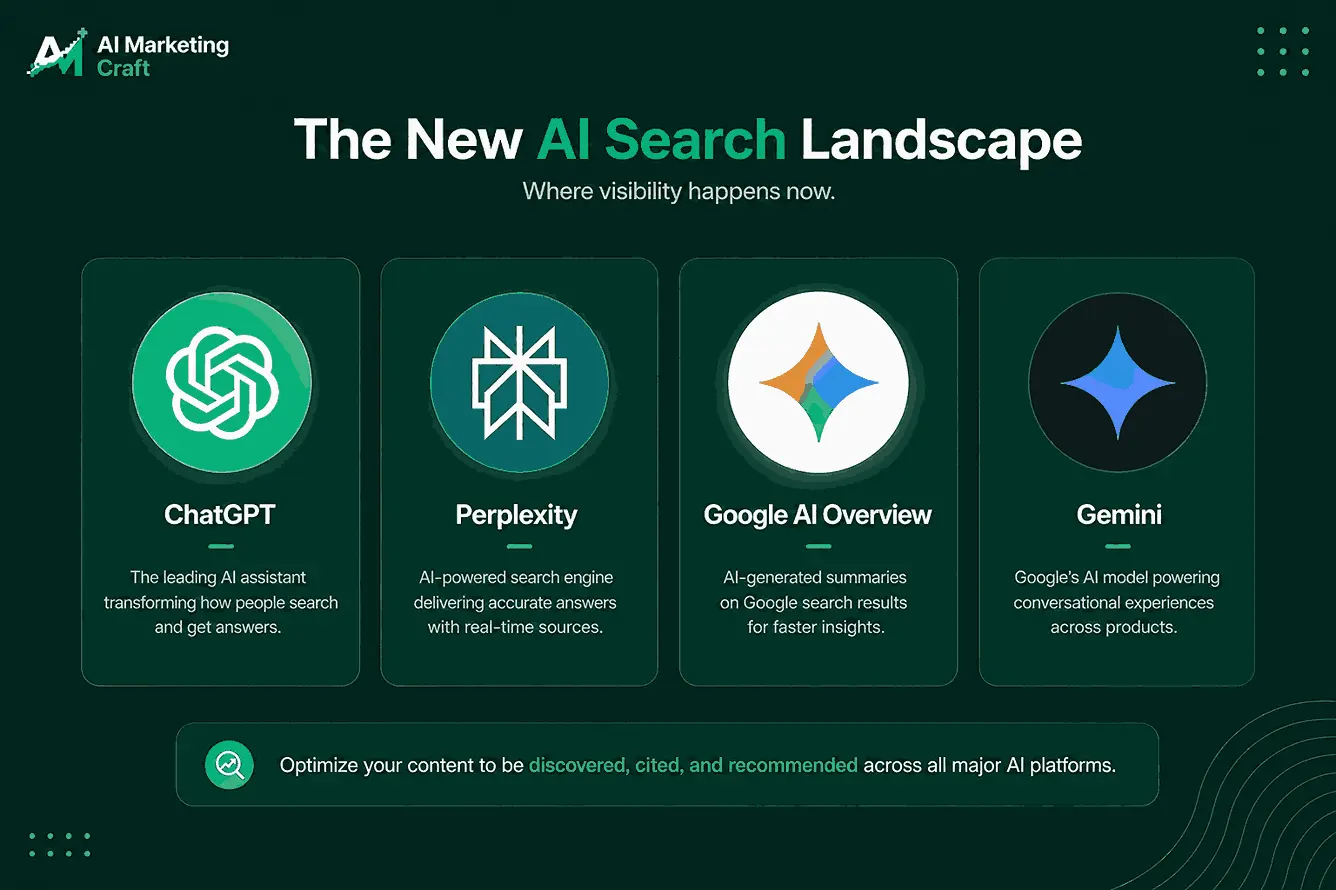
Does what works on ChatGPT also work on Perplexity? Not exactly — here’s what changes per platform.
Treating “AI search” as one monolith is one of the most common mistakes marketers make. Each platform has distinct retrieval logic, citation patterns, and content preferences. Optimizing for one without understanding the others means leaving visibility on the table.
ChatGPT Search (87.4% of all AI referral traffic)
ChatGPT dominates AI referral traffic — 87.4% of all AI-referred sessions come from ChatGPT (Conductor, 2026). This is where the most traffic is, and where your optimization efforts will see the highest return.
ChatGPT uses Google’s search index via SerpAPI for real-time web search. This means if Google can’t find you, ChatGPT probably can’t either. But there’s a key difference: ChatGPT favors brands that appear frequently across multiple credible sources, not just one authoritative post. Think of it as a reputation system — the more consistently you appear across trusted domains, the more ChatGPT trusts you.
ChatGPT-specific tactics:
- Build topical authority clusters — multiple interconnected posts on related subjects
- Earn mentions on high-DA sites (DA 60+), not just backlinks — links from DA 60+ sites are top-5 predictors of ChatGPT citation (SE Ranking, 2025)
- Get featured in “best of” listicles on authoritative sites — mentions in those lists directly increase ChatGPT citation probability
- Sites with profiles on Trustpilot, G2, or Capterra have 3x higher chances of being selected as a ChatGPT source (SE Ranking, November 2025)
Perplexity AI
Perplexity is the citation-heavy research engine — it’s built to show sources prominently. Users who choose Perplexity are actively looking for verifiable, sourced information. This makes your citing strategy here different.
Perplexity has a strong freshness bias. A one-week-old blog post on an authoritative domain gets cited more readily than a two-year-old evergreen piece (Starmorph, 2026). It also pulls 40% more citations from high-authority websites compared to mid-tier blogs.
Perplexity-specific tactics:
- Keep your key pages visibly updated — show “last updated” dates prominently
- Publish fresh content on recurring topics quarterly
- Use short, direct answer formats at the top of each section
- Include source citations within your content (citing external data makes you more citable)
Google AI Overviews & AI Mode
Google AI Overviews now appear in 25.11% of all searches (Conductor, 2026), covering nearly 1.5 billion monthly users. The good news: if you’re already doing solid SEO, you have a foundation here.
Google AI Overviews pull heavily from Google’s own index, but the relationship between traditional rankings and AI Overview citations is shifting fast. In July 2025, 76% of cited URLs ranked in the organic top 10. By February 2026, that dropped to 38% — with 31% of citations coming from pages not even in the top 100 (Frase, 2026). This means structured content can outcompete higher-ranked pages for AI Overview inclusion.
Google AI Overview-specific tactics:
- Implement FAQ schema and Article schema — these directly feed the AI Overview format
- Use clear H2/H3 hierarchy with question-format headings
- Ensure fast page load pages with FCP under 0.4 seconds average 6.7 citations, while slower pages average just 2.1 (Position Digital, April 2026)
- Allow Googlebot and Google-Extended to crawl your content
Gemini, Claude, and Copilot
These platforms each have distinct personalities:
Gemini leans on Google’s existing authority signals and Knowledge Graph associations. Strong structured data and clear entity definition matters most here.
Claude prefers long-form, comprehensive guides with clear logical structure. It favors depth over brevity, making it well-suited for detailed evergreen content.
Microsoft Copilot leans heavily on LinkedIn for B2B queries — meaning your company’s LinkedIn presence directly influences Copilot citations in professional contexts.
Cross-platform principle: Brand mentions correlate 3x more with AI citations than backlinks do (OmniSEO Research, 2026). Being talked about across authoritative third-party sites — reviews, forums, directories, media coverage — is the most reliable cross-platform signal.
How to Implement AEO: The 6-Step Framework
What does it actually take to start getting cited — and where do you begin?
AEO isn’t a single tactic. It’s a system. Here are the six components that work together.
Step 1: Answer-First Content Structure
AI engines extract passages, not pages. The harder you make it to find the answer inside your content, the less likely you are to be cited.
The principle is simple: answer the question in the first 40–60 words of every section. Then expand with context, data, and nuance.
Use question-format H2 headings. “How does AEO work?” performs better than “AEO Mechanics Overview” — for humans and AI alike. Structure your content with clear semantic chunking: each section covers one distinct topic, one question.
Content format checklist for AI extraction:
- Lead each section with the direct answer
- Use bullet points for lists (not dense paragraphs)
- Use numbered steps for processes
- Use tables for comparisons
- Include at least one statistic with a source citation per section
A critical stat from Growth Memo: 44.2% of all LLM citations come from the introduction (Growth Memo, February 2026). Your first 300 words are your most valuable real estate.
Step 2: Schema Markup — The Shortcut AI Engines Love
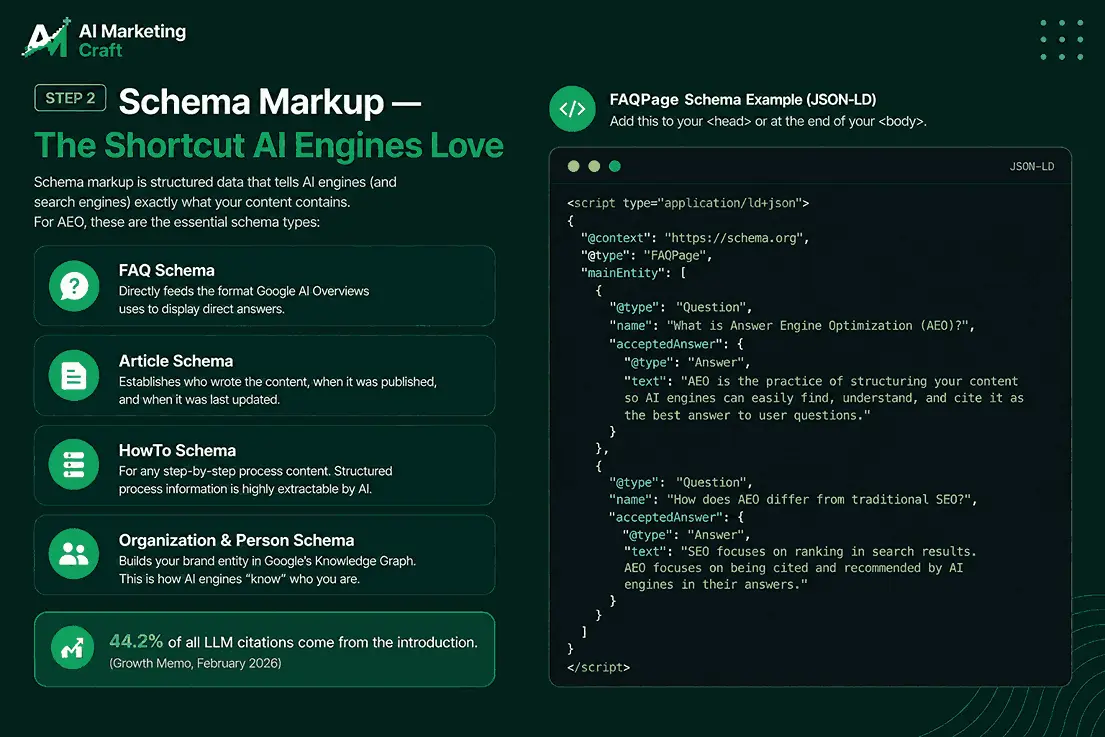
Schema markup is structured data that tells AI engines (and search engines) exactly what your content contains. For AEO, these are the essential schema types:
FAQ Schema — directly feeds the format Google AI Overviews uses to display direct answers. Every FAQ section in your content should be marked up with the FAQPage schema.
Article Schema — establishes who wrote the content, when it was published, and when it was last updated. This directly impacts the freshness signals AI engines use to rank sources.
HowTo Schema — for any step-by-step process content. Structured process information is highly extractable by AI.
Organization and Person Schema — builds your brand entity in Google’s Knowledge Graph. This is how AI engines “know” who you are.
Step 3: Entity Optimization and Brand Signals
Here’s the insight most guides skip: AI engines don’t evaluate your site in isolation. They infer trust from the broader web.
Mentions, citations, partner pages, business listings, reviews, PR coverage, and topic associations all contribute to how AI engines perceive your authority on a topic. This is the “entity optimization” layer — establishing your brand as a clearly recognized entity across the web.
For established brands: audit your presence on Trustpilot, G2, Capterra, industry directories, and relevant forums. For newer sites: start with Google Business Profile, LinkedIn company page, Crunchbase, and author bio pages on authoritative publications.
Distributing your content to a wide range of publications can increase AI citations by up to 325% compared to only publishing on your own site (Stacker, December 2025). Domains active on Reddit and Quora have roughly 4x higher chances of being cited by ChatGPT than those with minimal community presence (SE Ranking, November 2025).
Step 4: Build a Topical Authority Cluster — Not Isolated Posts
One excellent post does not build AEO authority. AI engines favor sources that demonstrate comprehensive, consistent expertise across a topic — not a single standalone article.
The hub-and-spoke model works like this: this “What is AEO” post is your hub. Surrounding it are spoke posts that go deeper: “How to do AEO,” “AEO tools comparison,” “AEO for SaaS companies,” “How to measure AEO ROI,” “AEO case studies.” Each spoke links back to the hub and reinforces your topical authority on the subject.
This isn’t just an SEO strategy. It’s how AI engines build trust in a source. Comprehensive topic coverage signals that you’re not just writing a post — you’re building a knowledge base.
Step 5: Freshness Strategy — Preventing Citation Decay
Here’s a fact almost no AEO guide mentions: AI citations decay. Content that stops getting cited can fall out of an AI engine’s active retrieval pool — particularly on recency-biased platforms like Perplexity.
Research shows pages updated within 2 months earn 28% more citations than older content (Superlines, March 2026). Create a refresh calendar: update core statistics quarterly, add new sections as the topic evolves, and update the dateModified field in your Article schema whenever you do.
This is especially important for “what is” guides like this one — the core answer doesn’t change, but the data, platform specifics, and best practices do. A guide with a “last updated April 2026” date signals freshness. A guide that looks untouched since 2023 signals risk.
Step 6: Technical AEO — What Actually Matters
Not all technical optimization is equal. Focus on what actually affects AI citation:
- Allow AI crawlers. Check your robots.txt. If you’re blocking GPTBot, ClaudeBot, or PerplexityBot, you’re opting out of citation. Allow the crawlers of platforms where you want to appear.
- Ensure fast load times. Pages with FCP under 0.4 seconds earn 3x more citations than slow pages (Position Digital, 2026).
- Use clean HTML structure. 46% of ChatGPT bot visits begin in reading mode — plain HTML, no CSS, no JS (Search Engine Land, October 2025). Content that renders cleanly in plain HTML gets read more reliably.
- Semantically relevant URL slug. Pages with URLs that match their content topic are more likely to be cited by ChatGPT (Ahrefs, April 2026).
AEO for New Websites: Starting From Zero Authority
Can a brand-new website actually compete for AI citations against established players?
Every major AEO guide assumes you have an established domain with years of authority. None of them address what you should do when you’re starting fresh.
Here’s the truth: new websites face a real challenge in AEO because domain authority is the strongest predictor of AI citation. But there’s a genuine opportunity that most new sites miss — being AI-native from day one.
Older sites have legacy content that wasn’t built for AI extraction. Their existing posts are keyword-stuffed, bury answers in paragraphs, and have no schema markup. A new site built correctly from the first post has a structural advantage over established competitors who are still retrofitting their content.
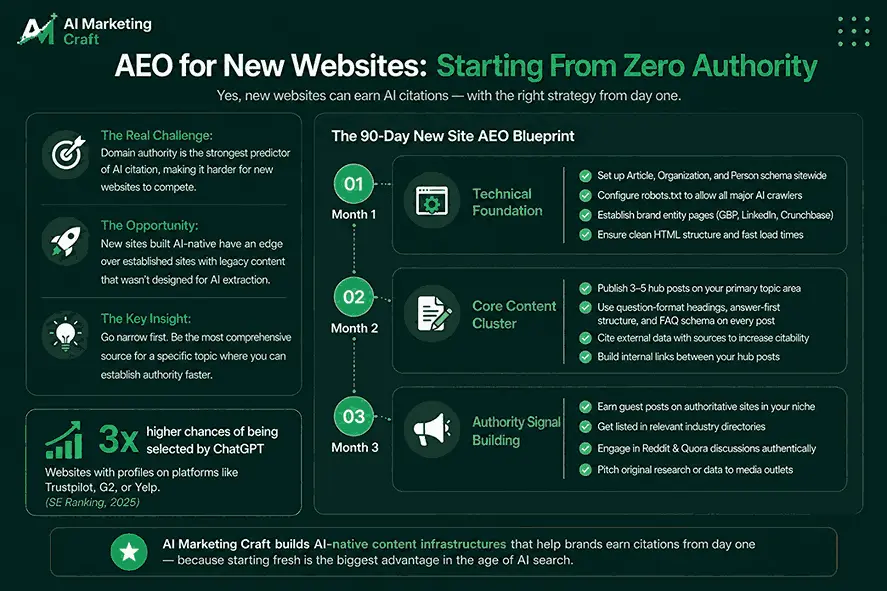
The 90-day new site AEO blueprint:
Month 1 — Technical Foundation:
- Set up Article, Organization, and Person schema sitewide
- Configure robots.txt to allow all major AI crawlers
- Establish brand entity pages: Google Business Profile, LinkedIn, Crunchbase
- Ensure clean HTML structure and fast load times
Month 2 — Core Content Cluster:
- Publish 3–5 hub posts covering your primary topic area comprehensively
- Use question-format headings, answer-first structure, and FAQ schema on every post
- Cite external data with sources — this alone significantly increases your citability
- Build internal links between your hub posts immediately
Month 3 — Authority Signal Building:
- Seek guest post opportunities on authoritative sites in your niche
- Get listed in relevant industry directories
- Engage authentically in relevant Reddit communities and Quora discussions
- Pitch original research or data to media outlets in your space
The key insight for new sites: don’t compete on broad terms immediately. Pick the narrowest, most specific version of your topic where you can be the most comprehensive source that exists. Narrow authority compounds faster than broad authority.
Sites with profiles on platforms like Trustpilot, G2, or Yelp have 3x higher chances of being selected by ChatGPT (SE Ranking, 2025). Even without customer reviews yet, claiming those profiles builds entity signals. Teams like AI Marketing Craft are building exactly this kind of AI-native content infrastructure for brands entering the AEO space — the advantage of starting fresh is that every decision can be optimized for how AI engines work today, not retrofitted for how search worked ten years ago.
How to Measure AEO Success
What metrics actually tell you if your AEO strategy is working?
Traditional metrics lie to you in an AEO context. Your page visits might drop even as your brand influence grows — because AI engines cite you without sending a click. Measuring only traffic is like judging a PR campaign by how many press releases you sent.
The new AEO measurement framework:
AI Citation Frequency — how often your brand is cited in AI-generated answers for your target queries. Track this by manually querying ChatGPT, Perplexity, Gemini, and Google AI Overview with your target questions weekly. Note who gets cited, and track changes over time.
AI Referral Traffic — visible in Google Analytics 4. Filter your referral traffic by source: chat.openai.com, perplexity.ai, gemini.google.com. This is real, trackable traffic from AI citations. Track it as a standalone channel.
Share of Voice in AI — your citation frequency relative to competitors across target queries. If your competitor appears in 7 of 10 AI answers for “best [your category] tool” and you appear in 2, that’s your AEO competitive gap.
Brand Mention Accuracy — how AI systems describe your brand when they mention it. Query AI engines with your brand name and examine the response. Is the description accurate? Positive? Up to date? Incorrect AI brand descriptions require a content correction strategy.
Assisted Conversions from AI — even zero-click AI citations influence decisions. Track contact form submissions, demo requests, and purchases that arrive from AI referral sources in GA4. HubSpot reports 3x better lead conversion coming from AEO compared to other search sources (HubSpot, 2026).
Free measurement method for new sites (no paid tools required):
- Create a spreadsheet of your 20 most important target questions
- Every two weeks, query each question in ChatGPT, Perplexity, and Google
- Note: are you cited? Is a competitor cited? Is anyone cited?
- Track changes over time
- In GA4, add a custom channel group for AI referral sources
This takes 30 minutes bi-weekly and gives you the data you need before investing in paid tools.
AEO Tools: What’s Available in 2026
Which tools actually help you track and improve AI citations — and which ones are hype?
The AEO tooling space exploded in 2025–2026. A word of caution first: no tool can guarantee AI placement. Anyone promising that is selling smoke. What tools can do is give you data, track trends, and surface optimization opportunities.
Purpose-built AEO/GEO tracking platforms:
| Tool | Best for | Key capability |
|---|---|---|
| Frase | Content + SEO teams | Dual SEO/AEO scoring, AI citation tracking across 8 platforms, content optimization |
| OmniSEO | Multi-platform tracking | ChatGPT, Perplexity, AI Overview, Gemini trackers; share of voice monitoring |
| HubSpot AEO | Brands using HubSpot CRM | AI visibility across ChatGPT, Perplexity, Gemini with conversion attribution |
| Profound | Enterprise brands | Full-scale AI brand monitoring, citation frequency, mention accuracy |
| Semrush | Teams with existing Semrush access | AI mention tracking integrated into broader SEO workflow |
| SE Ranking | Mid-market brands | AI citation tracking with competitive benchmarking |
Free tools that help:
- Google Search Console — watch for high-impression, low-click queries. These often indicate your content is appearing in AI Overviews where users get the answer without clicking
- Google Analytics 4 — set up custom channel groups to track AI referral traffic from ChatGPT, Perplexity, and Gemini
- Manual testing — query ChatGPT, Perplexity, and Google directly with your target questions. Free, fast, and highly informative.
Important context: The AEO tool market is genuinely nascent. Standard “AI citation share” KPIs are still being developed across the industry. Broad adoption of unified measurement standards is expected by 2026 (AIO Tools review, January 2026). For now, combine manual tracking with one platform-specific tool rather than over-investing in multiple overlapping solutions.
AEO Content Checklist: 15 Points Before You Publish
Use this before publishing any content you want cited by AI engines:
Structure:
- [ ] The main question is answered in the first 40–60 words
- [ ] All H2 and H3 headings are in question format where appropriate
- [ ] Each section covers one distinct topic (no section sprawl)
- [ ] FAQ section with at least 5 target questions added
Data and authority:
- [ ] Every major statistic has an inline source citation
- [ ] At least one comparison table included
- [ ] External links to 5+ authoritative sources
Technical:
- [ ] Article schema implemented (author, datePublished, dateModified)
- [ ] FAQPage schema implemented on all FAQ items
- [ ] Page load time tested (target FCP under 0.4 seconds)
- [ ] AI crawlers allowed in robots.txt (GPTBot, ClaudeBot, PerplexityBot)
- [ ] URL slug matches the primary topic
E-E-A-T signals:
- [ ] Author bio visible with credentials
- [ ] “Last updated” date displayed prominently
- [ ] Organization schema linking this content to your brand entity
The Bottom Line: Your Content Needs to Be the Answer, Not a Link to the Answer
Search didn’t die. It evolved. And right now, most brands are still playing the old game while the rules have changed.
AI engines are answering 60% of queries without a click. The brands that appear in those answers are building brand recognition, pipeline quality, and authority with every single AI response — even without a traditional page visit.
AEO isn’t a replacement for SEO. It’s the next layer on top of it. The structure is the same — authoritative, well-researched, technically sound content. The optimization target has shifted from ranking on a page to being chosen as the source.
Your first move: open ChatGPT, Perplexity, and Google right now. Type the five most important questions your ideal customer would ask about what you do. See who’s cited. If it’s not you, you know exactly where your opportunity is.
AI Marketing Craft covers the intersection of AI and marketing — from LLM optimization and Google AI Overview strategy to content frameworks for the AI-first search era. We test these strategies on real websites and report what actually moves the needle.
What is answer engine optimization (AEO)?
AEO is the practice of structuring your content so that AI-powered platforms, such as ChatGPT, Perplexity, Google AI Overview, and Gemini, select it as a cited source when generating answers to user queries. Unlike SEO, which targets search rankings, AEO targets the citation moment inside an AI-generated answer.
What are some answer engine optimization examples?
When ChatGPT answers “what is the best CRM for startups” and names three specific tools, those brands have effective AEO. When Google AI Overview pulls a definition directly from your blog post and displays it above the search results, that’s your content performing through AEO. When Perplexity answers a research question and links to your article as a source, that’s an AEO win.
What are the best answer engine optimization tools?
In 2026, leading AEO tools include Frase (dual SEO/AEO scoring), OmniSEO (multi-platform tracking), HubSpot AEO (CRM-integrated), Profound (enterprise), and Semrush (AI mention tracking). For free options: Google Search Console, GA4 referral tracking, and manual platform testing are highly effective starting points.
Is there an answer engine optimization course?
Yes — several platforms now offer AEO courses. HubSpot Academy has published AEO-specific learning content. Coursera and LinkedIn Learning have SEO courses being updated to include AEO principles. Several independent consultants (search “AEO course 2026”) offer specialized training. Quality varies significantly — prioritize courses that include case studies with measurable AEO outcomes.
Is there a free answer engine optimization course?
HubSpot Academy offers free digital marketing content that increasingly covers AEO. Semrush Academy’s free SEO courses are being updated to include AI search visibility. YouTube channels from practitioners like Aleyda Solis, Kevin Indig, and Rand Fishkin regularly publish free AEO-relevant content with real data.
What is the difference between AEO and GEO (Generative Engine Optimization)?
AEO optimizes for the answer-retrieval layer — ensuring your content is extracted and displayed as a direct answer in featured snippets, voice assistants, and AI answer boxes. GEO is broader — optimizing your entire digital presence so large language models cite you within synthesized, multi-paragraph AI responses. In practice, the signals overlap significantly, and both disciplines complement each other.
What is AEO agentic engine optimization?
“Agentic” AEO refers to optimization for AI agents — systems like ChatGPT’s operator mode, Anthropic’s Claude agents, and Google’s Gemini agents that autonomously research, browse, and complete tasks on behalf of users. As agentic AI grows, the technical requirements for AEO expand: structured data, accessible APIs, and machine-readable product information become critical because AI agents make purchasing and research decisions programmatically, not just informatively.
AEO vs GEO: which should I prioritize?
Start with AEO fundamentals — answer-first structure, FAQ schema, clear headings, and fresh data. These directly improve GEO performance as well. Once your core content is structured correctly, expand into GEO tactics: entity building, cross-platform brand mentions, and authoritative third-party coverage. The most effective 2026 strategy combines SEO + AEO + GEO as integrated, mutually reinforcing disciplines.
Does AEO replace SEO?
No. SEO builds the domain authority that AI engines use to decide which sources to trust. 38% of AI Overview citations come from pages already ranking in Google’s top 10. Strong SEO and strong AEO compound each other. The brands winning in 2026 are optimizing for both simultaneously.
How long does AEO take to show results?
Structural changes (schema, answer-first formatting) can influence AI citations within 2–4 weeks for platforms like Perplexity with strong freshness bias. Building the entity and authority signals that drive ChatGPT citations takes 3–6 months of consistent effort. For new websites without existing domain authority, the realistic timeline for measurable AI citation improvement is 3–6 months with a focused content cluster strategy.